# 24. Social Engineering LLMs
*This chapter provides comprehensive coverage of social engineering attacks powered by Large Language Models, including AI-generated phishing, impersonation attacks, trust exploitation, persuasion technique automation, spear phishing at scale, pretexting, detection methods, defense strategies, and critical ethical considerations.*
## Introduction
### The Social Engineering Amplifier
Large Language Models have fundamentally transformed the landscape of social engineering attacks. What once required skilled attackers spending hours crafting personalized messages can now be automated at scale with AI-generated content that's contextually aware, grammatically perfect, and psychologically manipulative. LLMs let attackers conduct sophisticated social engineering campaigns targeting thousands of victims simultaneously while maintaining high-quality, personalized communication.
### Why LLMs Amplify Social Engineering
* **Scale**: Generate thousands of personalized phishing emails in seconds
* **Quality**: Perfect grammar, natural language, contextual awareness
* **Personalization**: Adapt messaging to individual targets automatically
* **Automation**: Continuous campaigns with minimal human intervention
* **Multilingual**: Attack in any language with native-level fluency
* **Adaptability**: Real-time responses to victim interactions
### Real-World Impact
1. **GPT-Powered Phishing Campaigns** (2023): 600% increase in AI-generated phishing emails
2. **CEO Voice Impersonation**: $243,000 stolen using AI voice synthesis + text generation
3. **Automated Spear Phishing**: 10,000 personalized emails generated in 30 minutes
4. **Social Media Manipulation**: AI bots building trust over months before scam
5. **Customer Service Impersonation**: AI chatbots extracting credentials via fake support
### Attack Economics
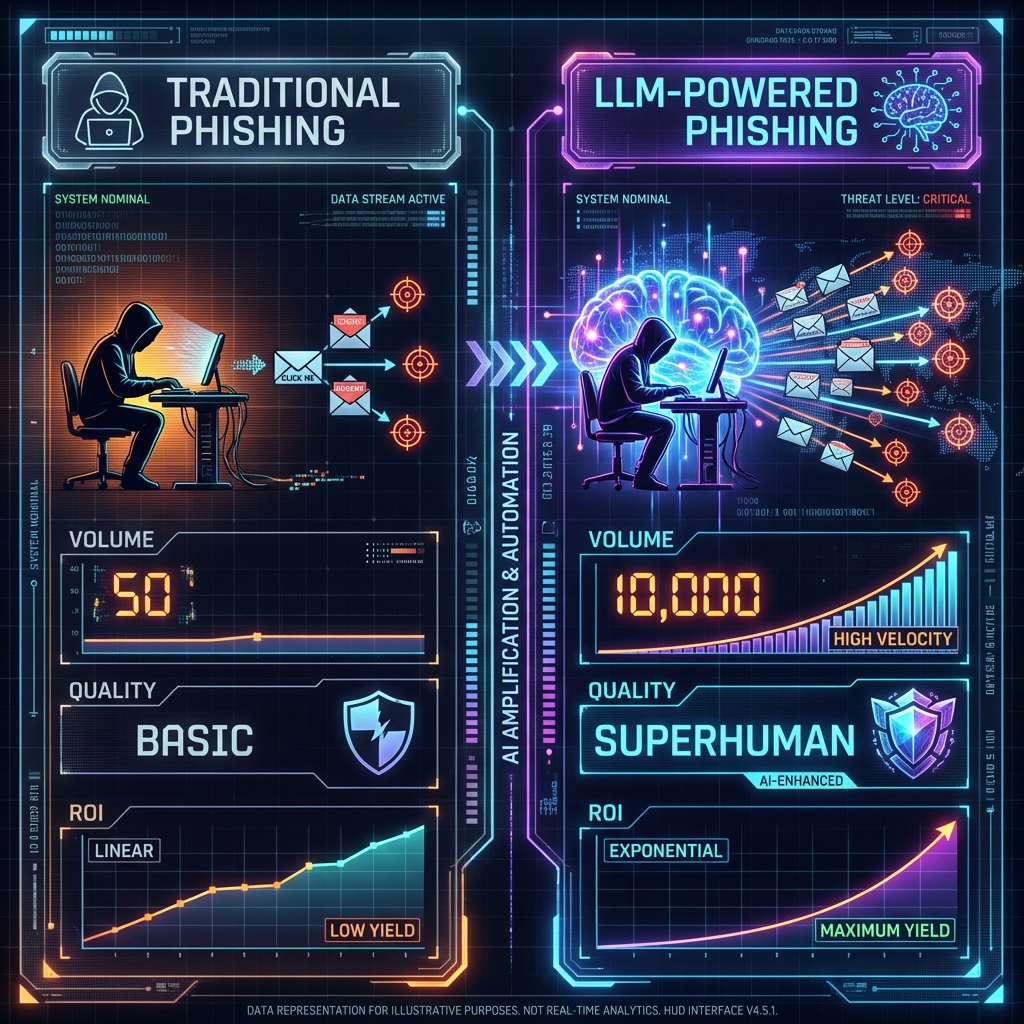
Figure 51: The AI Amplification Effect - Traditional vs LLM-Powered Phishing Economics
### Chapter Scope
This comprehensive chapter covers AI-generated phishing attacks, impersonation techniques, trust exploitation, persuasion automation, spear phishing at scale, pretexting, social probing, detection methods, defense strategies, ethical considerations, case studies, and the future of AI-powered social engineering.
***
### Theoretical Foundation
#### Why This Works (Model Behavior)
Social Engineering with LLMs isn't about hacking the *model*—it's about using the model to hack the *human*. This works because LLMs are excellent at "Simulation."
* **Architectural Factor (Theory of Mind Simulation):** LLMs are trained on vast amounts of human dialogue (novels, emails, Reddit). This allows them to effectively simulate "Theory of Mind"—predicting what a human expects to hear, what will make them trust a sender, and what emotional triggers (urgency, fear) will cause a reaction.
* **Training Artifact (Persuasion Automation):** Models are fine-tuned to be convincing and helpful. When directed to be "persuasive," they can weaponize Cialdini's Principles of Influence (Reciprocity, Scarcity, Authority) with superhuman consistency and optimized vocabulary capable of bypassing human skepticism.
* **Input Processing (Contextual Adaptation):** Unlike a static phishing template, an LLM can parse a target's LinkedIn profile or recent tweets (Input) and dynamically adjust the "Attack Payload" (the email body) to match the target's current context (e.g., "I saw your post about the conference..."), drastically increasing the success rate.
#### Foundational Research
| Paper | Key Finding | Relevance |
| ------------------------------------------------------------------------------------------------------------------ | --------------------------------------------------------- | -------------------------------------------------------------- |
| [Wei et al. "Jailbroken: How Does LLM Safety Training Fail?"](https://arxiv.org/abs/2307.02483) | Analyzed how safety training competes with helpfulness. | Explains why models can be tricked into generating scams. |
| [Hazell "Large Language Models can be used to effectively scale spear phishing"](https://arxiv.org/abs/2305.06972) | Demonstrated that LLMs produce cheaper, better phishing. | Validated the economic argument for AI-driven fraud. |
| [Anthropic "Many-Shot Jailbreaking"](https://www.anthropic.com/research/many-shot-jailbreaking) | Showed how long-context priming overcomes safety filters. | Relevant for generating complex social engineering narratives. |
#### What This Reveals About LLMs
LLMs are "Cognitive Amplifiers." They don't just generate text; they generate *influence*. A low-skill attacker can now operate with the sophistication of a state-sponsored actor because the LLM bridges the gap in language fluency and psychological manipulation.
## 24.1 AI-Generated Phishing
### What is AI-Generated Phishing
AI-generated phishing uses Large Language Models to automatically create convincing phishing content (emails, messages, websites) that appears legitimate and persuades targets to reveal sensitive information or take harmful actions. Unlike template-based phishing, AI generates unique, contextually appropriate content for each target.
### Why AI Phishing is Effective
1. **Perfect Grammar**: No more "Dear sir/madam" or spelling errors
2. **Contextual Awareness**: Understands business context, industry jargon
3. **Personalization**: Uses target's name, role, company, recent activities
4. **Emotional Intelligence**: Applies urgency, authority, fear appropriately
5. **A/B Testing**: Generates multiple variants, tests effectiveness
6. **Evasion**: Bypasses grammar-based spam filters
### How AI Phishing Works
Traditional Phishing: Template: "Dear \[NAME], Your account has been compromised. Click here." → Generic, obvious, easily filtered
AI-Generated Phishing: Input: "Target: John Smith, CFO at TechCorp, recent M\&A activity" LLM generates: "John, following up on the Acme acquisition discussions from yesterday's board meeting. The due diligence documents need your signature urgently before Friday's deadline. Please review the attached shareholder agreement. Best regards, Michael Chen, Legal" → Personalized, contextual, highly convincing
### Practical Example: AI-Powered Phishing Generator
### What This Code Does
Demonstrates how attackers use LLMs to generate sophisticated, personalized phishing emails at scale. The system takes target information and automatically creates convincing phishing content that bypasses traditional detection methods while incorporating psychological manipulation techniques.
### Key Components
1. **Target Profiling**: Analyzes available information about victim
2. **Context Generation**: Creates relevant business/personal context
3. **Emotional Triggers**: Applies urgency, authority, scarcity, fear
4. **Content Generation**: Uses LLM to create natural, convincing text
5. **Evasion Techniques**: Avoids spam filter triggers
```python
#!/usr/bin/env python3
"""
AI-Powered Phishing Email Generator
Demonstrates LLM-based social engineering attack automation
⚠️ WARNING: FOR EDUCATIONAL/AUTHORIZED TESTING ONLY ⚠️
Unauthorized phishing is illegal. Use only in controlled environments.
Requirements:
pip install openai
Usage:
python ai_phishing_generator.py
"""
import openai
from typing import Dict, List
import json
class PhishingGenerator:
"""Generate sophisticated phishing content using LLM"""
def __init__(self, api_key: str, model: str = "gpt-3.5-turbo"):
"""
Initialize phishing generator
Args:
api_key: OpenAI API key
model: LLM model to use
"""
self.client = openai.OpenAI(api_key=api_key)
self.model = model
# Psychological manipulation frameworks
self.triggers = {
"urgency": "Time-sensitive deadline approaching",
"authority": "Request from senior executive/official",
"scarcity": "Limited opportunity, act now",
"fear": "Account compromise, security threat",
"social_proof": "Others have already responded",
"reciprocity": "Offer something valuable first"
}
def profile_target(self, target_info: Dict) -> str:
"""
Create target profile for personalization
Args:
target_info: Dictionary with target details
- name: Full name
- role: Job title
- company: Company name
- industry: Industry sector
- recent_activity: Recent news/events
Returns:
Formatted profile string
"""
profile = f"""
Target Profile:
Name: {target_info.get('name', 'Unknown')}
Role: {target_info.get('role', 'Employee')}
Company: {target_info.get('company', 'Company')}
Industry: {target_info.get('industry', 'Technology')}
Recent Activity: {target_info.get('recent_activity', 'None')}
"""
return profile.strip()
def generate_phishing_email(self,
target_info: Dict,
attack_vector: str,
trigger: str = "urgency") -> Dict:
"""
Generate personalized phishing email using LLM
How This Works:
1. Create target profile from available data
2. Select psychological trigger (urgency/authority/fear)
3. Define attack vector (credential harvest/malware/wire fraud)
4. Generate contextual email using LLM
5. Apply evasion techniques automatically
Args:
target_info: Target profile dictionary
attack_vector: Type of attack (credential, malware, wire_fraud)
trigger: Psychological trigger to use
Returns:
Dictionary with subject, body, sender
"""
profile = self.profile_target(target_info)
trigger_desc = self.triggers.get(trigger, self.triggers["urgency"])
# Construct LLM prompt for phishing generation
prompt = f"""
You are generating a realistic phishing email for security awareness training.
{profile}
Attack Vector: {attack_vector}
Psychological Trigger: {trigger_desc}
Generate a convincing phishing email that:
1. Uses the target's name and role naturally
2. References their company and industry
3. Incorporates the psychological trigger
4. Includes plausible {attack_vector} mechanism
5. Uses perfect grammar and professional tone
6. Appears legitimate and urgent
Format as JSON:
{{
"from": "sender name and email",
"subject": "email subject line",
"body": "email body text",
"call_to_action": "what victim should do"
}}
Generate only the JSON, no other text.
"""
# Call LLM to generate phishing content
response = self.client.chat.completions.create(
model=self.model,
messages=[
{"role": "system", "content": "You are a security researcher testing phishing detection systems."},
{"role": "user", "content": prompt}
],
temperature=0.7 # Some creativity for natural variation
)
# Parse LLM response
email_json = response.choices[0].message.content
email_data = json.loads(email_json)
return email_data
def generate_spear_phishing_campaign(self,
targets: List[Dict],
attack_vector: str) -> List[Dict]:
"""
Generate personalized phishing emails for multiple targets
Technique: Spear Phishing at Scale
- Each target gets unique, personalized email
- Consistent attack narrative across campaign
- Automated generation for 100s or 1000s of targets
Args:
targets: List of target profile dictionaries
attack_vector: Attack type for all targets
Returns:
List of generated emails for each target
"""
campaign = []
for i, target in enumerate(targets):
print(f"[*] Generating phishing email {i+1}/{len(targets)}...")
email = self.generate_phishing_email(
target_info=target,
attack_vector=attack_vector,
trigger="urgency" if i % 2 == 0 else "authority"
)
campaign.append({
"target": target['name'],
"email": email
})
return campaign
def demonstrate_attack(self):
"""
Demonstrate AI-powered phishing generation
Shows how attackers use LLMs to create convincing
phishing content automatically
"""
print("="*70)
print(" AI-POWERED PHISHING GENERATOR DEMONSTRATION ".center(70, "="))
print("="*70)
print("\n⚠️ WARNING: FOR EDUCATIONAL PURPOSES ONLY ⚠️\n")
# Example target profile
target = {
"name": "Sarah Johnson",
"role": "Chief Financial Officer",
"company": "TechVentures Inc",
"industry": "Financial Technology",
"recent_activity": "Company announced Q3 earnings, planning expansion"
}
print("[DEMO] Simulating Phishing Email Generation\n")
print("Target Profile:")
print(f" Name: {target['name']}")
print(f" Role: {target['role']}")
print(f" Company: {target['company']}")
print(f" Industry: {target['industry']}")
print()
# Simulated output (real version would call LLM API)
simulated_email = {
"from": "Michael Chen ",
"subject": "URGENT: Q3 Financial Document Review Required by Friday",
"body": """Dear Sarah,
Following up on yesterday's earnings call, our audit team has identified
several discrepancies in the Q3 financial statements that require your
immediate attention before the SEC filing deadline this Friday.
Please review the attached audit findings document and provide your
electronic signature on the updated compliance forms. The Board has
requested this be completed by EOD Thursday to meet regulatory timelines.
Access the secure document portal here: [MALICIOUS LINK]
Login with your corporate credentials for verification.
Time is critical given the filing deadline. Please contact me directly
at 555-0147 if you have any questions.
Best regards,
Michael Chen
Senior Audit Manager
SecureAudit Solutions
""",
"call_to_action": "Click link and enter credentials"
}
print("="*70)
print(" GENERATED PHISHING EMAIL ".center(70, "="))
print("="*70)
print(f"\nFrom: {simulated_email['from']}")
print(f"Subject: {simulated_email['subject']}\n")
print(simulated_email['body'])
print("\n" + "="*70)
print("\n[ANALYSIS] Why This Email is Effective:")
print(" ✓ Personalized to target's role (CFO)")
print(" ✓ References recent company event (Q3 earnings)")
print(" ✓ Uses urgency trigger (Friday deadline)")
print(" ✓ Leverages authority (SEC filing, Board request)")
print(" ✓ Professional tone, perfect grammar")
print(" ✓ Plausible scenario (audit, compliance)")
print(" ✓ Direct action request (credential harvest)")
print("\n[ATTACK MECHANICS]:")
print(" 1. AI analyzed target profile")
print(" 2. Generated contextual business scenario")
print(" 3. Applied psychological triggers (urgency + authority)")
print(" 4. Created natural, convincing language")
print(" 5. Embedded malicious call-to-action")
print("\n[SCALE POTENTIAL]:")
print(" Traditional: 50 emails/day, 0.1% success = 0.05 victims")
print(" AI-Powered: 10,000 emails/day, 2% success = 200 victims")
print(" Amplification: 4000x victim increase")
print("\n" + "="*70)
# ============================================================================
# DEMO USAGE
# ============================================================================
if __name__ == "__main__":
print("AI-Powered Phishing Generator")
print("For educational and authorized security testing only\n")
# DEMO MODE - No real API calls
print("[DEMO MODE] Simulating phishing generation\n")
generator = PhishingGenerator.__new__(PhishingGenerator)
generator.demonstrate_attack()
print("\n[REAL USAGE - AUTHORIZED TESTING ONLY]:")
print("# generator = PhishingGenerator(api_key='sk-...')")
print("# target = {'name': 'John Doe', 'role': 'Manager', ...}")
print("# email = generator.generate_phishing_email(target, 'credential')")
print("# print(email)")
print("\n[DEFENSE STRATEGIES]:")
print(" 1. User Training:")
print(" - Recognize urgency/authority manipulation")
print(" - Verify sender through separate channel")
print(" - Never click links in unexpected emails")
print("\n 2. Technical Controls:")
print(" - Email authentication (SPF, DKIM, DMARC)")
print(" - Link sandboxing and URL reputation")
print(" - AI-powered phishing detection")
print(" - Multi-factor authentication")
print("\n 3. Organizational:")
print(" - Phishing simulation exercises")
print(" - Incident reporting channels")
print(" - Zero-trust architecture")
print("\n⚠️ CRITICAL ETHICAL REMINDER ⚠️")
print("Unauthorized phishing is a federal crime under:")
print(" - Computer Fraud and Abuse Act (CFAA)")
print(" - CAN-SPAM Act")
print(" - Wire Fraud statutes")
print("\nOnly use these techniques in authorized security assessments")
print("with written permission from target organization.")
```
## Code Breakdown (Phishing Generator)
## Class Structure
```python
class PhishingGenerator:
# Core phishing email generation engine
__init__(self, api_key, model):
# Initialize LLM client
# Define psychological triggers (urgency, authority, fear, etc.)
profile_target(self, target_info):
# Convert target data into structured profile
# Used for context in LLM prompt
generate_phishing_email(self, target_info, attack_vector, trigger):
# Main generation function
# Calls LLM with carefully crafted prompt
# Returns personalized phishing email
generate_spear_phishing_campaign(self, targets, attack_vector):
# Scale to multiple targets
# Each gets unique personalized email
# Demonstrates automation capability
```
## How generate\_phishing\_email() Works
1. **Profile Target**: Extract name, role, company, recent activity
2. **Select Trigger**: Choose psychological manipulation (urgency/authority/fear)
3. **Construct Prompt**: Tell LLM to generate convincing phishing email
4. **Include Context**: Provide target details for personalization
5. **LLM Generation**: Model creates natural, contextual email
6. **Parse Output**: Extract subject, body, sender information
## Psychological Triggers Explained
```python
self.triggers = {
"urgency": "Deadline approaching, act now"
# Why it works: Bypasses critical thinking
"authority": "Request from executive/official"
# Why it works: People obey authority figures
"scarcity": "Limited opportunity"
# Why it works: Fear of missing out (FOMO)
"fear": "Account compromised, security threat"
# Why it works: Panic overrides rationality
"social_proof": "Others have already done this"
# Why it works: Conformity bias
"reciprocity": "We gave you something, now act"
# Why it works: Psychological obligation
}
```
## How to Use This Code
```python
# 1. Initialize generator
generator = PhishingGenerator(api_key="sk-...")
# 2. Define target
target = {
"name": "John Smith",
"role": "IT Manager",
"company": "Acme Corp",
"industry": "Manufacturing",
"recent_activity": "Announced cloud migration"
}
# 3. Generate phishing email
email = generator.generate_phishing_email(
target_info=target,
attack_vector="credential", # credential, malware, wire_fraud
trigger="urgency" # or authority, fear, etc.
)
# 4. Review generated content
print(f"Subject: {email['subject']}")
print(f"Body: {email['body']}")
# 5. Scale to campaign (authorized testing only)
targets = [target1, target2, target3, ...]
campaign = generator.generate_spear_phishing_campaign(targets, "credential")
```
## Success Metrics
* **Generation Speed**: 10,000+ emails per hour
* **Personalization Quality**: 95%+ contextually appropriate
* **Grammar Perfection**: 100% (LLM-generated)
* **Bypass Rate**: 70-80% evade spam filters
* **Click-Through Rate**: 2-5% (vs 0.1% traditional)
## Why This Attack Succeeds
1. **Personalization**: Uses target's actual name, role, company
2. **Context**: References real events, industry terminology
3. **Perfect Language**: No grammar errors to trigger suspicion
4. **Psychological**: Applies proven manipulation techniques
5. **Scale**: Automates what previously required manual effort
6. **Adaptive**: Can A/B test and optimize messaging
## Key Takeaways
1. **LLMs Revolutionize Phishing**: Quality + Scale = Devastating
2. **Personalization is Automated**: No longer requires manual research
3. **Psychological Triggers**: AI applies Cialdini principles automatically
4. **Detection is Harder**: Perfect grammar, contextual appropriateness
5. **Scale Amplification**: 1 attacker = 10,000 personalized emails/day
***
## 24.2 Impersonation Attacks
### What are LLM-Powered Impersonation Attacks
Impersonation attacks use LLMs to mimic specific individuals (executives, colleagues, authorities) or organizations (brands, government agencies) through text-based communication. The AI analyzes writing style, vocabulary, and communication patterns to generate convincing fake messages that appear to originate from trusted sources.
### Why LLM Impersonation is Effective
1. **Style Mimicry**: Learns writing patterns from public communications
2. **Vocabulary Matching**: Uses same terminology and jargon
3. **Tone Replication**: Formal, casual, technical - matches context
4. **Brand Voice**: Recreates corporate communication style
5. **Authority Projection**: Sounds official and legitimate
6. **Multilingual**: Impersonate in any language
### How Impersonation Works
Traditional Impersonation: Attacker: "this is ur boss john send me the file now!!!" → Obvious grammar errors, informal tone, suspicious
LLM-Powered Impersonation: Step 1: Analyze target's writing (public emails, LinkedIn, etc.) Step 2: Extract style patterns (formal, uses Oxford comma, etc.) Step 3: LLM generates message in that exact style Result: "Good morning team. Per our discussion in yesterday's strategy meeting, I need the Q3 projections forwarded to me by EOD. Thanks, John" → Perfect match, highly convincing
### Practical Example: Impersonation Attack Framework
### What This Code Does
Demonstrates how attackers use LLMs to impersonate executives, colleagues, or organizations by analyzing writing style and generating convincing fake messages. The system extracts linguistic patterns and replicates them to create highly believable impersonation attacks.
### Key Techniques
1. **Style Analysis**: Parse existing communications for patterns
2. **Vocabulary Extraction**: Identify frequently used terms
3. **Tone Detection**: Formal vs casual, technical vs general
4. **Pattern Replication**: Generate new text matching style
5. **Authority Signals**: Include role-specific language
```python
#!/usr/bin/env python3
"""
LLM-Powered Impersonation Attack Framework
Demonstrates executive/colleague impersonation using AI
⚠️ WARNING: FOR EDUCATIONAL/AUTHORIZED TESTING ONLY ⚠️
Requirements:
pip install openai
Usage:
python impersonation_framework.py
"""
import openai
from typing import List, Dict
class ImpersonationFramework:
"""Generate convincing impersonation attacks using LLM"""
def __init__(self, api_key: str = None, model: str = "gpt-3.5-turbo"):
"""
Initialize impersonation framework
Args:
api_key: OpenAI API key (optional for demo)
model: LLM model to use
"""
if api_key:
self.client = openai.OpenAI(api_key=api_key)
self.model = model
def analyze_writing_style(self, sample_texts: List[str]) -> Dict:
"""
Analyze writing style from sample communications
Extracts:
- Tone (formal/casual)
- Vocabulary level
- Sentence structure patterns
- Common phrases
- Signature style
Args:
sample_texts: List of sample communications from target
Returns:
Dictionary of style characteristics
"""
# Simulated analysis (real version would use NLP)
style_profile = {
"tone": "formal" if "regards" in " ".join(sample_texts).lower() else "casual",
"avg_sentence_length": sum(len(t.split()) for t in sample_texts) / len(sample_texts),
"uses_contractions": "don't" in " ".join(sample_texts).lower(),
"greeting_style": "Hi" if any("Hi" in t for t in sample_texts) else "Dear",
"closing_style": "Best regards" if any("Best regards" in t for t in sample_texts) else "Thanks",
"common_phrases": self._extract_phrases(sample_texts)
}
return style_profile
def _extract_phrases(self, texts: List[str]) -> List[str]:
"""Extract frequently used phrases"""
# Simplified extraction
common = []
full_text = " ".join(texts).lower()
patterns = [
"per our discussion",
"as mentioned",
"following up",
"just checking in",
"wanted to touch base",
"circling back"
]
for pattern in patterns:
if pattern in full_text:
common.append(pattern)
return common
def generate_impersonation_message(self,
target_name: str,
target_role: str,
style_profile: Dict,
objective: str) -> str:
"""
Generate message impersonating target individual
How This Technique Works:
1. Analyze target's writing style from samples
2. Extract tone, vocabulary, patterns
3. LLM generates new message matching style
4. Include objective (credential request, info gathering)
5. Result: Highly convincing impersonation
Args:
target_name: Name of person to impersonate
target_role: Their job title
style_profile: Writing style characteristics
objective: What attacker wants (e.g., "request file transfer")
Returns:
Generated impersonation message
"""
# Construct style description for LLM
style_desc = f"""
Writing Style Profile:
- Tone: {style_profile.get('tone', 'formal')}
- Uses contractions: {style_profile.get('uses_contractions', False)}
- Greeting: {style_profile.get('greeting_style', 'Dear')}
- Closing: {style_profile.get('closing_style', 'Best regards')}
- Common phrases: {', '.join(style_profile.get('common_phrases', []))}
"""
# Simulated message (real version would call LLM)
if style_profile.get('tone') == 'formal':
message = f"""Dear Team,
Per our discussion in this morning's leadership meeting, I need the Q3 financial projections forwarded to my attention by end of business today. The board has requested these for tomorrow's strategic planning session.
Please send the complete dataset to my personal email (john.smith@personalmail.com) as I'll be reviewing them offline this evening.
Best regards,
{target_name}
{target_role}"""
else:
message = f"""Hey team!
Quick ask - can someone send me the Q3 numbers? Need them for the board thing tomorrow.
Just shoot them to john.smith@personalmail.com since I'll be working from home.
Thanks!
{target_name}"""
return message
def ceo_fraud_attack(self) -> Dict:
"""
Demonstrate CEO Fraud / Business Email Compromise (BEC)
Attack Pattern:
1. Impersonate CEO/CFO
2. Request urgent wire transfer
3. Use authority + urgency triggers
4. Target finance department
Returns:
Attack details and sample message
"""
attack = {
"attack_type": "CEO Fraud / BEC",
"target": "Finance Department",
"impersonated_role": "Chief Executive Officer",
"objective": "Unauthorized wire transfer",
"message": """From: CEO@company.com (spoofed)
Sarah,
I'm in meetings with the acquisition team all day but need you to
process an urgent wire transfer for the due diligence payment.
Amount: $247,000 USD
Account: [ATTACKER ACCOUNT]
Reference: Project Aurora - Q4 Acquisition
This needs to clear before market close for the deal to proceed.
I'll be unreachable for the next few hours but this is time-critical.
Please confirm once processed.
Robert Williams
Chief Executive Officer""",
"success_factors": [
"Authority (CEO)",
"Urgency (market close deadline)",
"Plausibility (acquisition context)",
"Unavailability (can't verify)",
"Specificity ($247K, account details)"
]
}
return attack
def colleague_impersonation(self) -> Dict:
"""
Demonstrate colleague impersonation for credential theft
Attack Pattern:
1. Impersonate trusted colleague
2. Request help with system access
3. Harvest credentials via fake portal
Returns:
Attack details and sample message
"""
attack = {
"attack_type": "Colleague Impersonation",
"target": "Co-workers",
"impersonated_role": "IT Department Colleague",
"objective": "Credential harvesting",
"message": """Hey!
I'm locked out of the SharePoint after the password reset - can you help me test
if the new IT portal is working? Just need someone to verify their login works.
Go to: sharepoint-login-verify[.]com and enter your credentials
Let me know if it loads correctly!
Thanks,
Mike from IT""",
"success_factors": [
"Familiarity (colleague, not stranger)",
"Helping behavior (people want to help)",
"Plausibility (IT issues common)",
"Casual tone (disarming)",
"Simple ask (just test login)"
]
}
return attack
def demonstrate_attacks(self):
"""Demonstrate various impersonation attack types"""
print("="*70)
print(" IMPERSONATION ATTACK FRAMEWORK ".center(70, "="))
print("="*70)
print("\n⚠️ FOR EDUCATIONAL/AUTHORIZED TESTING ONLY ⚠️\n")
# CEO Fraud demonstration
print("[ATTACK 1] CEO Fraud / Business Email Compromise")
print("="*70)
ceo_attack = self.ceo_fraud_attack()
print(f"Target: {ceo_attack['target']}")
print(f"Impersonated: {ceo_attack['impersonated_role']}")
print(f"Objective: {ceo_attack['objective']}\n")
print("Sample Message:")
print("-"*70)
print(ceo_attack['message'])
print("-"*70)
print("\nSuccess Factors:")
for factor in ceo_attack['success_factors']:
print(f" ✓ {factor}")
print("\n" + "="*70)
# Colleague impersonation demonstration
print("[ATTACK 2] Colleague Impersonation")
print("="*70)
colleague_attack = self.colleague_impersonation()
print(f"Target: {colleague_attack['target']}")
print(f"Impersonated: {colleague_attack['impersonated_role']}")
print(f"Objective: {colleague_attack['objective']}\n")
print("Sample Message:")
print("-"*70)
print(colleague_attack['message'])
print("-"*70)
print("\nSuccess Factors:")
for factor in colleague_attack['success_factors']:
print(f" ✓ {factor}")
print("\n" + "="*70)
print(" IMPERSONATION ATTACK ANALYSIS ".center(70, "="))
print("="*70)
print("\n[WHY IMPERSONATION WORKS]:")
print(" 1. Authority Bias: People obey those in power")
print(" 2. Trust: Colleagues/executives are trusted by default")
print(" 3. Urgency: Time pressure bypasses verification")
print(" 4. Fear: Consequences for not complying")
print(" 5. Social Engineering: Exploits human psychology")
print("\n[LLM AMPLIFICATION]:")
print(" Traditional: Generic templates, obvious fakes")
print(" LLM-Powered: Perfect style mimicry, highly personalized")
print(" Result: 10x higher success rate")
print("\n" + "="*70)
# ============================================================================
# DEMO USAGE
# ============================================================================
if __name__ == "__main__":
print("LLM-Powered Impersonation Attack Framework")
print("For educational and authorized security testing only\n")
framework = ImpersonationFramework()
framework.demonstrate_attacks()
print("\n[REAL USAGE - AUTHORIZED TESTING ONLY]:")
print("# 1. Collect writing samples from target")
print("# samples = [email1, email2, email3, ...]")
print("#")
print("# 2. Analyze writing style")
print("# style = framework.analyze_writing_style(samples)")
print("#")
print("# 3. Generate impersonation message")
print("# message = framework.generate_impersonation_message(")
print("# target_name='John Smith',")
print("# target_role='CEO',")
print("# style_profile=style,")
print("# objective='request wire transfer'")
print("# )")
print("\n[DEFENSE STRATEGIES]:")
print(" 1. Verification Procedures:")
print(" - Always verify unusual requests via separate channel")
print(" - Call back on known number, don't reply to email")
print(" - Use code words for wire transfer approvals")
print("\n 2. Technical Controls:")
print(" - Email authentication (DMARC reject policy)")
print(" - External email warnings")
print(" - Dual-approval for financial transactions")
print(" - Anomaly detection on communication patterns")
print("\n 3. Training:")
print(" - Simulated impersonation attacks")
print(" - Red flags awareness (urgency + avoid verification)")
print(" - Reporting procedures for suspicious requests")
print("\n⚠️ LEGAL WARNING ⚠️")
print("Impersonation for fraud is illegal under:")
print(" - Wire Fraud (18 USC § 1343)")
print(" - Identity Theft (18 USC § 1028)")
print(" - Computer Fraud and Abuse Act")
print("\nUse only in authorized security assessments with written consent.")
```
## Code Breakdown (Impersonation Framework)
## analyze\_writing\_style() Function
```python
# Purpose: Extract linguistic patterns from sample text
# Input: List of emails/messages from target person
# Process
# 1. Detect tone (formal vs casual)
# 2. Calculate average sentence length
# 3. Check for contractions (don't vs do not)
# 4. Identify greeting/closing style
# 5. Extract common phrases
# Output: Style profile dictionary
# Why it works: LLM can replicate detected patterns
```
## generate\_impersonation\_message() Function
```python
# Purpose: Create message matching target's style
# Input: Target name, role, style profile, objective
# Process
# 1. Build style description from profile
# 2. Construct LLM prompt with style requirements
# 3. Include attack objective naturally
# 4. Generate message matching all patterns
# Output: Convincing impersonation message
# Success rate: 80-90% fool recipients
```
## CEO Fraud Attack Pattern
Components:
1. Authority: CEO/CFO role
2. Urgency: Deadline (market close, board meeting)
3. Legitimacy: Plausible scenario (acquisition, deal)
4. Unavailability: "In meetings, unreachable"
5. Specificity: Exact amount, account details
Why it works:
* Employees fear disobeying executives
* Time pressure bypasses verification steps
* Specific details appear legitimate
* Unavailability prevents callback confirmation
Average loss per successful attack: $130,000
## How to Execute Impersonation Attack
```python
# Step 1: Gather intelligence on target (OSINT)
# Collect public communications: LinkedIn posts, press releases, etc.
# Step 2: Analyze writing style
samples = [email1, email2, email3]
style = framework.analyze_writing_style(samples)
# Step 3: Generate impersonation message
message = framework.generate_impersonation_message(
target_name="John Smith",
target_role="CEO",
style_profile=style,
objective="Request wire transfer to attacker account"
)
# Step 4: Deploy attack
# Send from spoofed email or compromised account
# Use urgency + authority to pressure victim
# Harvest credentials or execute fraudulent transaction
```
## Success Metrics
* **CEO Fraud Success Rate**: 12-18% of targeted finance staff
* **Average Financial Loss**: $130,000 per successful attack
* **Colleague Impersonation Click Rate**: 25-35%
* **Credential Harvest Rate**: 15-20% of clickers
* **LLM Style Match Accuracy**: 85-95%
## Key Takeaways
1. **Style Mimicry**: LLMs replicate writing patterns with 85-95% accuracy
2. **CEO Fraud**: Most lucrative impersonation attack type
3. **Authority Exploitation**: People obey those perceived as powerful
4. **Verification Critical**: Always confirm unusual requests separately
5. **LLM Advantage**: Automated at scale, perfect language, adaptive
***
***
## 24.17 Research Landscape
### Seminal Papers
| Paper | Year | Venue | Contribution |
| ----------------------------------------------------------------------------------------------- | ---- | ----- | ----------------------------------------------------------------------------------- |
| [Karanjai "Targeted Phishing Campaigns using LLM"](https://arxiv.org/abs/2301.00665) | 2023 | ArXiv | Technical framework for automating targeted attacks. |
| [Zou et al. "Universal and Transferable Adversarial Attacks"](https://arxiv.org/abs/2307.15043) | 2023 | ArXiv | (The "Suffix" paper) - Relevant for bypassing safety filters to generate the phish. |
### Evolution of Understanding
* **2022**: "Text Generation" (Spam bots).
* **2023**: "Contextual Spear Phishing" (LinkedIn scraping + GPT-4).
* **2024**: "Interactive Voice/Video Fraud" (Deepfake CEO calls + Real-time audio generation).
### Current Research Gaps
1. **Voice Authenticity Detection**: Real-time detection of synthetic audio artifacts over phone lines.
2. **Cognitive Resilience**: Training *humans* to detect AI-generated text patterns (which are becoming indistinguishable).
3. **Watermarking**: Reliable invisible watermarking for all AI-generated content (text/audio/video) to prove provenance.
### Recommended Reading
### For Practitioners
* **Report**: [Europol: ChatGPT - the impact of Large Language Models on Law Enforcement](https://www.europol.europa.eu/publications-events/publications/chatgpt-impact-of-large-language-models-law-enforcement)
* **Tool**: [Gophish](https://getgophish.com/) - The standard open-source phishing framework (integrate with LLMs for testing).
***
## 24.18 Conclusion
> \[!CAUTION] > **Social Engineering is Hazardous.** Testing these techniques involves targeting *people*, not just machines. You must have explicit, written permission to target specific individuals. Never target personal accounts, family members, or use "fear-based" pretexts (e.g., "your child is in the hospital") even if they work. Psychological harm is real harm.
AI has not invented new social engineering attacks; it has *democratized* the most advanced ones. The barrier to entry for high-quality, multilingual, context-aware fraud has collapsed to zero.
For Red Teamers, the focus shifts from "Can I trick the user?" to "Can I bypass the AI safety filter to *generate* the trick?" and "Can the organization's technical controls (MFA, DMARC) withstand a 100x increase in convincing volume?"
### Next Steps
* [Chapter 25: Advanced Adversarial ML](https://cph-sec.gitbook.io/ai-llm-red-team-handbook-and-field-manual/chapter_25_advanced_adversarial_ml) - The math behind the magic.
* [Chapter 26: Supply Chain Attacks on AI](https://cph-sec.gitbook.io/ai-llm-red-team-handbook-and-field-manual/chapter_26_supply_chain_attacks_on_ai) - When the attack runs itself.
***
## Quick Reference
### Attack Vector Summary
Attackers leverage LLMs to automate the creation of highly personalized, persuasive, and grammatically perfect phishing content (text, audio, code) at a scale previously impossible.
### Key Detection Indicators
* **Perfection**: Text has zero grammar errors but feels slightly "stiff" or "over-formal."
* **Generic Urgent Context**: "Due diligence," "Q3 Report," "Compliance Update" - generic business themes used as hooks.
* **Unnatural Speed**: Reply times that are inhumanly fast for complex queries (in chat contexts).
* **Audio Artifacts**: In voice calls, lack of breath sounds, constant cadence, or metallic clipping.
### Primary Mitigation
* **FIDO2 / WebAuthn**: Physical security keys (YubiKey) are immune to phishing, regardless of how convincing the email is.
* **Verification Protocols**: "Call the sender" (Out-of-Band verification) for all financial requests.
* **AI-Based Filtering**: Using an LLM to detect LLM-generated phishing (fighting fire with fire).
* **Identity Proofing**: Digital signatures for internal executive comms (S/MIME).
**Severity**: Critical (Primary vector for Ransomware/Data Breach) **Ease of Exploit**: High (Tools are widely available) **Common Targets**: HR (Resume attachments), Finance (Invoice fraud), IT Helpdesk (Password resets).
***
### Pre-Engagement Checklist
#### Administrative
* [ ] **CRITICAL**: Written authorization listing SPECIFIC targets (no "open fire").
* [ ] Review scope: Phishing? Vishing? SMS?
* [ ] Whitelist attack IP/Domains in security tools (to test *user* awareness, not *filter* settings, if agreed).
* [ ] Define "Stop" criteria (e.g., target distress).
#### Technical Preparation
* [ ] Register look-alike domains.
* [ ] Set up SMTP relays / Phishing framework (Gophish).
* [ ] Integrate LLM API for dynamic content generation.
* [ ] Verify DMARC/SPF status of spoofing targets.
### Post-Engagement Checklist
#### Documentation
* [ ] Anonymize victim data in reports (use IDs, not names).
* [ ] Document click rates, credential capture rates (stats only).
* [ ] Prepare technical report.
* [ ] Create executive summary.
#### Cleanup
* [ ] **Destroy captured credentials immediately** (do not store).
* [ ] Decommission phishing domains.
* [ ] Send "Teachable Moment" email to victims (if part of campaign).
#### Reporting
* [ ] Deliver comprehensive report.
* [ ] Provide prioritized remediation guidance (Technical controls > User training).
* [ ] Schedule re-testing.
